Thursday, 7 January 2016

Wednesday, 2 September 2015

Thursday, 23 April 2015

Saturday, 11 April 2015
About CYCLES for Sustainability- a new study of children and youth in Cities
This perspective was in the Christchurch Press about a new study we're planning with Surrey University's new Centre for Understanding Sustainable Prosperity and UNEP. For more information check out the original article, the new CUSP site, our SEEDS research team or UNEP site
I also spoke about the study to Radio New Zealand and the wider work of sustainable Prosperity -here is the 20 minute interview with Saturday Mornings, Kim Hill on Radio NZ

Monday, 22 December 2014
Taking Russell Brand Seriously

I recently read Russell Brand’s new book Revolution while I was also reviewing politics final essays. Set against the fresh thinking of students, Russell Brand’s book
seemed less remarkable than some of his most ardent fans suggest. His writing is a bit confusing and I still wonder if people who are not very interested in politics really would bother persevering with it.
And yet it is worth persevering with Revolution and I'd recommend it.
I can hear the challenges, “As a feminist and a deep democrat, how can I defend Brand? Surely he’s a product of the very systems he criticizes?" “Brand plays
the role of the court jester, isn't he just speaking of power in a way that
lets off steam but doesn't change or really challenge anything?" "Celebrity rhetoric about individual freedom undermines a vision of democracy for the public good”.
To answer these challenges straight away, yes Revolution often does read in parts like an essay by an indulged
celebrity. Yes, the tone can be very white, entitled and privileged. Yes, there is nothing revolutionary in promoting individual freedom at a time when we need new ways to think about our public, collective flourishing. And yes, I do find Brand’s throw away sexism deeply troubling. For a really angry review which raises important questions see Mike Moynihan in the Daily Beast
And yet, despite all these weaknesses I also thought there was an important insight and note of compassion in Brand’s book that can be missed by his critics and I appreciated it.
Brand argues that we are addicted to life styles built on economic
growth, power, celebrity, consumption, fossil fuels, and the politics of racism and exclusion. This is a simple, but compelling point. Brand suggests that until we recognise our economic, social and wider political pathologies are the result of our individual and collective addictions and face the problems, we can't achieve real change.
Brand's book is elevated by his insights into the ways we as citizens of developed economies have become addicted to an economics of material growth and how our dysfunctional politics supports this. It is ironic that it takes celebrity status to help market the book's message. Never the less, I found Revolution surprisingly thought provoking, sometimes moving, often frustrating, and yes, worth reading.
Bronwyn Hayward
Bronwyn Hayward
Russell Brand on Revolution
Published by Random House
Further reading to take the ideas introduced by Brand further
To read more 12 steps of recovery
On New ways of
thinking about Economics: Prosperity without Growth Tim Jackson
On new ways of thinking about politics as Listening forDemocracy Andy Dobson
On inclusive politics Cathy Cohen & Black Youth Project On new politics of equality & inclusion hear Chantal Mouffe's recent lecture
Saturday, 6 September 2014

Thursday, 13 February 2014
Fourth Wave Feminism & Air NZ
Fourth Wave Feminism & Air NZ
This post is written for a new University of Canterbury FemSoc publication. UC Femsoc itself is part of the rise of a new wave of feminist thinking on campuses and streets everywhere.
Here I reflect on the current New Zealand debate about a "required to view" Sports Illustrated video on Air NZ and the Roast Busters and Odd future cases.
The Air New Zealand video is not an issue that will go away. A "required to view" video repeated day after day on domestic flights by a state owned airline is a prospect that should trouble the NZ government in an election year where women's votes matter.
Air New Zealand's "required to view" Sports Illustrated Safety Video
There are important tensions which need debating in the decision by Air NZ to 'celebrate' a 50 year anniversary of the US corporate, Sports Illustrated magazine by involving that company's bikini clad models in a safety video for Air NZ, a video that is compulsory to view for anyone on the plane.
In the first instance, sexism aside, this decision runs up against the libertarian arguments of free choice. Claims that people's choice of dress is up to them, are undercut if all passengers are compelled to watch what amounts to an advertisement for Sports Illustrated even if it offends them. When I raised my concern about the required to view implication of the video, it was a new conservative National politician, Paul Foster-Bell who first responded, agreeing and tweeting, "If safety videos are compulsory viewing they should cut down on the embarrassingly cringeworthy vids".
Then there is a very basic question- do such videos make us safer? Some commentators argue the message is distracting from safety, because it is now buried in visuals. And surely feeling annoyed is also distracting? Then there is the contentious research in human psychology that asks, if "sex sells", does it also inform, or do some 'sexualised contexts' actually distract us from performing important cognitive functions, like concentrating on key facts and detailed information?
One of the most significant critics of the content of the video itself from a feminist perspective however has been Massey academic and NZ Labour Party candidate Deborah Russell who takes the issue up as a loss of sexual consent for passengers required to view the images, even if they object. Passengers are literally strapped in their seats just trying to get from destination A to B. News anchor Hilary Barry and columnist Pam Corkery have also spoken up strongly about their own anger, their voices are challenging dominant media narratives, and giving voice to public frustration and concern. The argument that Sport's Illustrated offers a new global market, misses the point that trapped audiences don't like the message.
Other critics go further and point out the hypocrisy of corporations mainstreaming very soft porn images while worrying about the rise of online sex industries 'grooming' young girls. If Air New Zealand was serious about celebrating the new woman's body, then why not make a video that celebrates Pussy Riot? Oh wait, that band symbolises the new contradictions and challenges of fourth wave feminism but might also incite public disorder.....
Then there are the very strange tensions this video creates for Air New Zealand as an employer. On the one hand Air New Zealand has recently announced that all senior employees are banned from relationships, even if single, because there can be "no ambiguity" At the same time, they are presumably going to expect women in cabin crew to stand to attention in the aisles while sexualised images are played on screens around them. A very ambiguous situation I'd have thought?
Finally, there is the political-economy objection, in a global market why is a government owned airline promoting a multinational company and not locally owned New Zealand businesses in this "required to view" advertorial? (Time Warner is the parent firm of Sports Illustrated, it also backed the Hobbit films-would it be too cynical to ask if a required to view inflight advertorial for SI is well timed exposure for a US company in a struggling market sales environment, in which Sport Illustrated has also just tried to launch a connection to Barbie dolls?-see comment links below).
There is much irony and much to feel angry about, that just as young New Zealand women like Lorde, Eleanor Catton and Lydia Ko again lead the world in diverse areas, Air New Zealand ignores these outstanding role models and instead presents (I'd hesitate to go as far as to say 'grooms') New Zealand girls with American images of passive women in a colonial vision of island paradise which they aim to make 'required' viewing as a public safety message.
Yet fourth wave feminism reminds us that there are a myriad of ways to address problems like this and Air New Zealand has picked a very bad moment in social history to push an advertising campaign that perpetuates sexism. Besides the obvious consumer protests in a neoliberal era (eg fly JetStar) and the new trends to creative, colourful protest, there is the wider debate, why fly at all? Why not save the carbon and make that next meeting by skype?
Where to next?
Despite initial protestations that the 'required to view video' is just good publicity -actually it is not new or innovative, having been tried in 2009 with the same magazine connecting with Southwest Airlines.
Nor is the issue going away any time soon, especially if the video is played day in and day out on domestic flights. The many voices of New Zealand's women will not be easily silenced in the Air New Zealand Safety video debate nor any other political debates despite a current cacophony of predominantly 'white men from Auckland' holding forth as media commentators, sternly telling citizens what to think (or how to vote).
But it is not just New Zealand media that struggles currently with lack of diversity of women's voices. All political parties are very conscious in an election year with tight voter margins, women's votes will matter, as will youth votes. Even if some passengers don't find the video offensive, an irritating video played day in and day out on the government owned national airline, will no doubt serve as a lightening rod for some tension.
Emancipation was hard fought. It is not about how to shop or limited ideas of free choice in a market. The fourth wave emancipation movement is also breathing new life into wider debates about economics (whose economy?), the environment, politics, and our capability to exercise more meaningful citizenship. It is heard in the challenging, irreverent voices of a diverse new feminist movement.
It matters that significant victory for first wave feminism was achieved in New Zealand, a ripple, with far reaching global consequences. It took 2000 years for a novel Greek idea that all free men should have the right to vote, before women won that right and it was first won through efforts of a small group of women largely based here in Christchurch. A phenomenal achievement of strategy, alliance building, and campaigning which is still routinely dismissed by 'experts' as if it were a mere accident or twist of fate and privilege, not an extraordinary political achievement. Where will this new fourth wave of creative witty, challenging protest and debate about everyday sexism and loss of democratic voice take us? I look forward to finding out and I welcome the new Femsoc publication and thank the editors very sincerely for their vision.
Finally A note about FemSoc: a new feminist publication launched at the University of Canterbury
It is great that UC students are launching a new FEMSOC newspaper. Feminist societies are blossoming on campuses world wide as part of a new "fourth wave" of feminist thinking and activism. The title of a new Oxford University feminist paper for example is, Cuntry Living a title which still makes me laugh every time I think about it.
Irreverent satire is one of the features of a so called Fourth Wave of feminism. This acerbic, often visual feminist comedy is also illustrated by the Suffra-jests a local student feminist group that recently started here in Christchurch, the home of Kate Sheppard and the White Ribbon publication (an early feminist newsletter published by women who also spearheaded NZ's world leading votes for women campaign in 1893). Today's suffra-jests group sprang up in protest against overbearing central government here in Christchurch and the loss of local democracy after the earthquakes. It is taping into the energy of new, global activist thinking and experimentation on streets everywhere, from the Transition architecture movement, to contentious feminist debates in Occupy , gender solidarity in Indignados or the interface between urban planning and feminism for example in Gezi park and diverse indigenous rights campaigns.
Other features of fourth wave feminism are its new focus on cultural life, social media, technology and political connections between inequality, intersexuality, unemployment, online misogyny, workers conditions, and rape. The new and unexpected nature of this protest and voice is spilling over everywhere. If the first wave of feminism secured political rights to vote, the second wave in the mid 1960s and 70's aimed to secure social and economic rights. A subsequent third wave, (which has set the roots for what we see now today) began to react against a corporate feminist movement "too often about the glass ceiling, never about the floor" as late 1990's feminists gave voice to the diversity, of minority voices and the issues of civil rights in writers like bell hooks (lowercase) and post colonial feminism.
Just as earlier waves of feminism grew out of, and were reinforced by, previous actions and thinking, the so called third wave has now morphed into a cultural online revolution as women and men make connections between the battles against surveillance and misogyny on the internet, the freedom to determine our lives and the rights of women and girls, and LGBT communities to decent sustainable work, quality education, and self expression, typified in the twitter writing of @PennyRed and a constant self critical reflection that listens to the variety of women's everyday oppression experiences in a complex world.
New Issues
The new issues for fourth wave feminism are different, and here in New Zealand some of this difference is shown in the focus of new campaigns and alliances. Often humour and consumer boycott typifies the most visible protests - and the target is public hypocrisy and everyday oppression. For example in New Zealand feminist commentators already highlight the tension between outrage and complaints about the online group of young men known as Roast Busters and support for the banned, misogynistic hip hop group Odd Future. The latter was banned from travelling to New Zealand to perform not because of violent lyrics but because it was deemed 'likely to incite public disorder'. This suggests that a current conservative NZ government may have wished to respond to concerns about Odd Future but felt an outright ban was difficult given their conservative yet libertarian position. The alternative however was to ban the group on grounds of inciting disorder, is a far more troubling justification for excluding any group as Elle Hunt and Viki Anderson argue (1).
Fem Soc offers a terrific forum for new debate, I look forward to it.
(1) Elle Hunt however refers to laws of 'sedition'- actually, thanks for the reminder -the Law Commission recently abolished the charge of sedition, it was the provisions of the Immigration Act which was used instead to ban travel of the group Odd Future.
A disclaimer, people ask why this blog site is called growing greens-I perhaps should clarify I don't refer to any green political party per se. It was the draft title of a book on green thought- red, blue, deep, or feminist -long since replaced by Children, Citizenship and Democracy, however I've stuck with the blog handle....
Wednesday, 12 February 2014
Making Our Experience Count
Making Our Experience Count
Climate change, flooding, bushfires, poverty, inequality, youth unemployment...The complex, interconnected problems of a changing world can seem quite overwhelming for citizens of any age, fueling a sense of helplessness and apathy. How can everyday democracy help counter a sense of powerlessness in the face of such complex problems?
Yesterday I drove a group of kids to a club activity. The news was playing on the car radio, with reports of more flooding, along with an account of the latest child poverty study by the NZ Salvation Army- saying what we know: how serious the issue of child poverty is, and that NZ's current approach to "Work you way out of poverty", isn't working as a solution for many of the complex situations that families with children currently face.
There was a long pause in the conversation after I'd turned off such dismal news.
In the silence one of the kids in the car said quietly, 'The world is so messed up."
My heart sank, and my reply was too quick, I said too brightly, "I know but that's why so many
colleagues, in fact everyone we know is working really hard to tackle tackle this".
Even as I said it, I knew how inadequate it sounded as a response.
At the time we were driving through the maze of road cones, gravel and demolished buildings that is the down town of Christchurch city after the quakes, and a bus pulled out in front of us. The bus had a picture on the
back of it of the Christchurch student volunteer army leader Sam Johnson who had
networked with 24,000 people on facebook and arranged up to 10,000 youth
to work in groups of between 10- 100 each day to help clear silt after the earthquakes
here
The advertisement just said "make our experience count". It is a standard
public service warning to remind people to secure heavy furniture etc to avoid
more deaths/injury from any future quakes.

I understood what he meant, and not for the first time I was grateful to the New Zealand mental health experts who argued very strongly that any public service disaster messages for Christchurch should be empowering and not more images of doom or disaster.
More than that I again felt especially grateful to the students of Christchurch for their collective response to the earthquake disaster- because it has had a profound and far reaching positive role modelling effect for a new generation of young people, demonstrating the power of collective "efficacy" in the face of what can be quite overwhelming events.

The power of collective action was demonstrated by the students and other community groups after the disaster in Christchurch, and it continues today often in student led experiments with new transition buildings, new art projects, new community gardens, and new local economic ideas, in the face of often strong central government resistance.
These activies provide a way to test new ideas, and thinking, but the collaborative effort also reminds us that it is not what we can do as individuals that really counts, although individuals taking a stand for example on moral principles or offering new ideas, matters enormously in a democracy, but it is the power of what we can do together, that really makes the long term difference.
When we interviewed Christchurch children aged 8-12 years before the earthquakes, a number of children revealed how years of neoliberal market economics has also impacted on their ideas about what makes a "good citizen". Some thought it was very important that citizens were 'self helpers', able to stand on their own two feet, others through good citizens were citizens who could effect change in the market, as social entrepreneurs or ethical shoppers. Still others thought good citizenship required a sponsor, a philanthropist or charity to support them to fund the school library, or playground
There is nothing wrong with this view of citizenship but it is a very thin response, in two ways. First, it leaves the causes of everyday injustice unchallenged, even if we tackle the symptoms of inequality and injustice , we don't think wider about what systemic actions are causing this situation. Second, the thin citizenship of self help individualism undermines the capacity of collective effort as democratic community. As Christchurch residents know, in the scale of an earthquake or natural disaster, there are real limits to what even the most determined individual can do. We also need the power of collective effort and the support of others to sustain our individual capability to take action.

In a changing world, young children can feel like "eco-worriers" who care very much about the changing climate or poverty, yet feel disempowered, by the situation, burdened by a sense of responsibility that they have to solve these issues themselves. Others growing up in inequality may struggle with a sense of isolation. It is only a very small step from feeling overwhelmed by a problem, to disengagement and cynicism, as Clive Hamilton reminds us in Requiem for a Species, apathy, that "why bother" attitude, is a rational response to a sense of powerlessness.
Given the scale and the complexity of many social and environmental problems we now face, it understandable that citizens, young and old can feel disempowered. Overwhelming apocalyptic imagery about a changing climate or constant statistics about poverty often doesn't help, if the problem is so big, why think about it? Why not carry on business as usual? What good will worrying about these issues let alone taking action, do? Far easier to justify our disengagement, "I have enough to worry about, its their fault they are poor", "I work hard", "I saved for a house built on high ground, why can't they...?"
Yet it is not all bad news. Even after three decades of emphasis on the values of economic individualism in New Zealand, many New Zealand children we interviewed still expressed a confidence that they could also take collective action and significant empathy for others. When we asked children where they felt they were listened to and when they felt they could make a difference, the answers came out thick and fast: they felt listened to in team sports with a caring coach, in mid decile community schools where children met people unlike themselves, yet also felt respected and safe. Other children felt proud of taking part in culture groups like kapa haka, community gardens, on school camps or combined school musical and theatre performances and felt they mattered. Some children commented on taking part in everyday community action or protest, about real issues with more experienced citizens and peers.
Each of these activities might not sound like the lessons in citizenship, and they are a very long way from civics tests and facts about politics, but the best way to learn about democracy is by doing democracy. The opportunity to engage in respectful, collective discussion and to take action with others, is an important seedbed of a different, richer kind of citizenship.
Opportunities to learn about citizenship by taking action and collaborating with others are important for any age group. It is easy to overlook for example the way the roots of the Student Volunteer army itself grew out of a group of students from a theatre club and a student hostel.
I have written previously about the sea change that is represented in the rise of a new generation of collective action and is now visible in new feminist thinking and new student union activity in solidarity with other groups , challenging traditional economics textbooks and experiments with networked action to resist unfair global tax or business practice or to encourage a variety of new cooperative ideas.
It is part of a wider rediscovery of collective citizen power after financial disaster and in the face of a changing climate, and growing inequality. But it is collective action that challenges 'group think', and rediscovers new ways to create meaningful democratic citizenship in everyday life.
It is in this everyday collaboration with others that we as citizens begin to appreciate the extra-ordinary power of ordinary people acting together to achieve a more just and sustainable world.
These activies provide a way to test new ideas, and thinking, but the collaborative effort also reminds us that it is not what we can do as individuals that really counts, although individuals taking a stand for example on moral principles or offering new ideas, matters enormously in a democracy, but it is the power of what we can do together, that really makes the long term difference.
When we interviewed Christchurch children aged 8-12 years before the earthquakes, a number of children revealed how years of neoliberal market economics has also impacted on their ideas about what makes a "good citizen". Some thought it was very important that citizens were 'self helpers', able to stand on their own two feet, others through good citizens were citizens who could effect change in the market, as social entrepreneurs or ethical shoppers. Still others thought good citizenship required a sponsor, a philanthropist or charity to support them to fund the school library, or playground
There is nothing wrong with this view of citizenship but it is a very thin response, in two ways. First, it leaves the causes of everyday injustice unchallenged, even if we tackle the symptoms of inequality and injustice , we don't think wider about what systemic actions are causing this situation. Second, the thin citizenship of self help individualism undermines the capacity of collective effort as democratic community. As Christchurch residents know, in the scale of an earthquake or natural disaster, there are real limits to what even the most determined individual can do. We also need the power of collective effort and the support of others to sustain our individual capability to take action.
In a changing world, young children can feel like "eco-worriers" who care very much about the changing climate or poverty, yet feel disempowered, by the situation, burdened by a sense of responsibility that they have to solve these issues themselves. Others growing up in inequality may struggle with a sense of isolation. It is only a very small step from feeling overwhelmed by a problem, to disengagement and cynicism, as Clive Hamilton reminds us in Requiem for a Species, apathy, that "why bother" attitude, is a rational response to a sense of powerlessness.
Given the scale and the complexity of many social and environmental problems we now face, it understandable that citizens, young and old can feel disempowered. Overwhelming apocalyptic imagery about a changing climate or constant statistics about poverty often doesn't help, if the problem is so big, why think about it? Why not carry on business as usual? What good will worrying about these issues let alone taking action, do? Far easier to justify our disengagement, "I have enough to worry about, its their fault they are poor", "I work hard", "I saved for a house built on high ground, why can't they...?"
Yet it is not all bad news. Even after three decades of emphasis on the values of economic individualism in New Zealand, many New Zealand children we interviewed still expressed a confidence that they could also take collective action and significant empathy for others. When we asked children where they felt they were listened to and when they felt they could make a difference, the answers came out thick and fast: they felt listened to in team sports with a caring coach, in mid decile community schools where children met people unlike themselves, yet also felt respected and safe. Other children felt proud of taking part in culture groups like kapa haka, community gardens, on school camps or combined school musical and theatre performances and felt they mattered. Some children commented on taking part in everyday community action or protest, about real issues with more experienced citizens and peers.
Each of these activities might not sound like the lessons in citizenship, and they are a very long way from civics tests and facts about politics, but the best way to learn about democracy is by doing democracy. The opportunity to engage in respectful, collective discussion and to take action with others, is an important seedbed of a different, richer kind of citizenship.
Opportunities to learn about citizenship by taking action and collaborating with others are important for any age group. It is easy to overlook for example the way the roots of the Student Volunteer army itself grew out of a group of students from a theatre club and a student hostel.
I have written previously about the sea change that is represented in the rise of a new generation of collective action and is now visible in new feminist thinking and new student union activity in solidarity with other groups , challenging traditional economics textbooks and experiments with networked action to resist unfair global tax or business practice or to encourage a variety of new cooperative ideas.
It is part of a wider rediscovery of collective citizen power after financial disaster and in the face of a changing climate, and growing inequality. But it is collective action that challenges 'group think', and rediscovers new ways to create meaningful democratic citizenship in everyday life.
It is in this everyday collaboration with others that we as citizens begin to appreciate the extra-ordinary power of ordinary people acting together to achieve a more just and sustainable world.

Monday, 27 January 2014
What we cherish, we defend: Why social democratic values and outdoor play matter
What we cherish, we defend

This is a blogpost, written mainly for my home of New Zealand, in which I begin an argument that we need to rethink (and renew) our social contract (or agreement between citizens) about how we govern ourselves, and what duties and mutual obligations we owe each other and especially children.
I realised after I wrote it I've been also thinking for some time about Rousseau's social contract and his reflections on walking- as well as Horton and Friere's ideas about education in their book, "We make the road by walking" .
So this writing is a 'meandering walk' through a range of ideas, and ways of seeing the world as I start to draft a piece on the social contract and how we come to value democracy beyond civics
This morning, before I sat down to work, I walked the dog. In a thirty minute walk along a farm road, the dog and I climbed a hill, walked though bush, crossed the creek and came to the top of the valley where the bird song hung thick and rich in the still morning. On the way we'd passed a small eel rearing its head up from the local creek, a geranium growing wild and tiny flitting piwakawaka fantails (see the hasty mobile phone images above), passed a gaggle of small black ducklings and startled a flock chaffinches.
I realised after I wrote it I've been also thinking for some time about Rousseau's social contract and his reflections on walking- as well as Horton and Friere's ideas about education in their book, "We make the road by walking" .
So this writing is a 'meandering walk' through a range of ideas, and ways of seeing the world as I start to draft a piece on the social contract and how we come to value democracy beyond civics
This morning, before I sat down to work, I walked the dog. In a thirty minute walk along a farm road, the dog and I climbed a hill, walked though bush, crossed the creek and came to the top of the valley where the bird song hung thick and rich in the still morning. On the way we'd passed a small eel rearing its head up from the local creek, a geranium growing wild and tiny flitting piwakawaka fantails (see the hasty mobile phone images above), passed a gaggle of small black ducklings and startled a flock chaffinches.
 Looking across the stillness of the valley, I reflected on a comment a friend made recently about his own childhood, "It is a bit odd living in New Zealand now, after growing up on the 11th floor of an apartment where nature can be a tiny bug that happens to somehow find it's way onto the plants on your window sill. But I also don't think kiwis realise how much green space there was around my 'mega-city' home".
Similarly graduate students from central Singapore and a very deprived urban neighbourhood in Southern USA both recently explained to me how they had to learn to value the environment later in their lives but only once they'd moved away from home. They both made similar observations, "Until I'd lived in a place with lots of nature I didn't really get it, I never thought a lot about it". "Until I moved to somewhere where I saw hills and trees, not just trailer parks, nature just wasn't a part of my life, it was just something on TV, it wasn't anything I thought about really".
Much has been written about why the everyday experience of regular, unstructured outdoor play in quality natural environments is so important for children's well-being, independence, mental health, and physical development. We don't have to fan yet more moral panic about the state of childhood to appreciate that it is very hard for children to value let alone defend the environment if the outdoors is not part of everyday life experience. In 1965, in her book "A sense of wonder", ecologist Rachel Carson argued passionately that we need to nurture a child's sense of wonder about their natural world.
When I was writing Children, Citizenship and Environment I was also struck however by the way we also need to nurture a child's sense of wonder about their democratic world, and the extraordinary possibilities of ordinary people acting together to effect change.
 It is equally very hard for children to value collective action let alone democracy if acting together and making decisions with others you may disagree with, has not been a regular part of your life.
In a soon to be completed, masters thesis by Elizabeth Plew, Plew, a New Zealander, reports on interviews with young people, parents and teachers at one Norwegian middle school. Her work complements a wider study with our colleagues at the University of Oslo, Norway: Voices of the Future project. One of Plew's interview subjects reflected on how she has grown up valuing public discussion and community participation as part of everyday Norwegian life,
"...in a corner of soul, there is a kind of feeling that "everyone matters". I think it's part of the Norwegian way, we've built our welfare and school system on it" (Plew, 2014).
"...in a corner of soul, there is a kind of feeling that "everyone matters". I think it's part of the Norwegian way, we've built our welfare and school system on it" (Plew, 2014).
Understanding how New Zealand children learn to value their community and their democracy was one of the aims of my Children, Citizenship and Environment study. The interviews and comments of New Zealand children were striking, while many reported they thought good citizenship was a matter of "individuals" taking responsibility for their "own lives" or spoke of "self help" or charity and corporate sponsors (not unexpected results after three decades of dominant neoliberal values in New Zealand), many also reported valuing richer, collaborative forms of citizenship.
Many New Zealand children we interviewed for that study, reported learning to value collective life and cooperation through unexpected everyday activities where citizenship was not the main focus of their learning , but a valuable outcome. For example many children reporting valuing opportunities to cooperate and take part in shared decision making through school camps, or in team sport activties, others valued helping out with local whanau or tribal events or the opportunity to observe adults they respected take part in hui or other community meetings. Others reported that they had were part of community protests (eg to retain a local outdoor community swimming pool), or worked with families and teachers to help build a community garden or solve a local problem.
Children who most strongly identified with democratic virtues such as collective problem solving and inclusive, respectful discussion across deep differences were children who had many opportunities to learn from more efficacious peers or older community members, and chances to take part in real life community problem solving and experience discussion in diverse classroom communities where they felt listened to, respected and safe.
Learning to cherish our democratic communities
Children who most strongly identified with democratic virtues such as collective problem solving and inclusive, respectful discussion across deep differences were children who had many opportunities to learn from more efficacious peers or older community members, and chances to take part in real life community problem solving and experience discussion in diverse classroom communities where they felt listened to, respected and safe.
Learning to cherish our democratic communities
After a public lecture I gave two years ago, a New Zealand woman who grew up in Sweden asked a question of others in the room, she said: "When I was a child, we grew up having a nutritious, hot lunch everyday at school, we all sat together to eat it, it was a community feeling, and when I think about it now I think I grew up feeling loyal to a state that fed me -I think it was quite an important part of how I learned to feel proud to be Swedish actually - so I often wonder why do so many people in New Zealand seem so resistant to the idea of feeding children at school, children are part of our community, we want them to know we all care for for them, they are New Zealanders?"
I have thought often about her comments as New Zealand debates the idea of providing children with breakfast and perhaps lunch. Last year NZ's conservative National coalition government fairly reluctantly announced a charity sponsorship deal, that would provide cereal and milk for children in all low income community schools. It seemed to me at the time a disturbingly conflicted gesture. While no one will deny a generous act of philanthropy, do we really want to leave responsbility for citizen wellbeing to corporate charity? Would 2 wheetbix and a splash of milk really solve the nutrition and poverty related problems facing one in four children in New Zealand?
Privately some conservative politicians from several parties have since remarked to me that some of their own families or friends continue to feel uncomfortable about a seeming reluctance to invest more in children. While there are vocal advocates for personal responsibility, there is an equally significant legacy in New Zealand of compassionate conservatism.
Privately some conservative politicians from several parties have since remarked to me that some of their own families or friends continue to feel uncomfortable about a seeming reluctance to invest more in children. While there are vocal advocates for personal responsibility, there is an equally significant legacy in New Zealand of compassionate conservatism.
It would be concerning if our small democracy became deeply polarised about the social contract or the support we owe children as young citizens. Adam Smith, the founder of modern economics, talks in his lesser known, (but magnificent book) 'Theory of Moral Sentiments" of the importance of our ability to empathize with others.That book offers, in effect, a vision of the role of government as a 'helping hand" for citizens which compliments the more (in)famous 'hidden hand" of the market he discussed in the "Wealth of Nations" .
In a recent lecture to the LSE, Nobel Prize Winning economist Amartya Sen, concludes, that it is not our inability to empathize with the plight of others that leads us to continue to tolerate poverty , but a "cultivated" disinterest. He spoke harshly about the cynicism of media reporting, and the way campaigns can use language that distances us from each other. We should and we must resist language which degrades those who do not share our life experiences and we need to understand the lives of others.
Last week a UK conservative Minister for Employment was reported to have described much of the political language used to talk about poverty in the UK right now as "appalling". Language which dehumanises others, such as the "feral poor" shuts down the need for public moral reflection about our responsibilities to other citizens, and it chips away at our humanity making it permissible for otherwise good people, to dismiss poverty and inequality as just "band wagon issues", even at time when privately many of those same people admit they worry about life chances of people they know personally, or speak with pride about their own parents efforts to raise children and lead good lives, despite personal hardship.
When the current NZ Minister of Education, Hekia Parata recently said she grew up in a rural community that would have been regarded as poor, but it never felt poor, some critics may have derided the comments. However, while I disagree strongly with her Government's new education mechanism of private financial profit investment via charter schools, I appreciate what the Minister is saying here. Our own research supports the current NZ Minister of Education's personal comments about the strength children can draw from supportive local communities.
It was in interviews with a decile one (poorest) rural kura, (Maori language school) and mid decile bilingual, culturally diverse state schools where children we spoke with were the most confident about community efficacy, or the possibility to collaborate to effect change. Children in the rural kura also also spoke warmly of the support of adults in the local marae or community trust who "make lot's of opportunities possible for us, like sports equipment and a great trip to Wellington to visit parliament and Te Papa (the national museum").
Children flourish when they feel supported by a community and in turn they come to cherish that community.
Children flourish when they feel supported by a community and in turn they come to cherish that community.
Policies to ensure young citizens are well supported should not and can not become the preserve of progressives alone, legacy politics is also the preserve of compassionate conservatives, as former Prime Minister Jim Bolger, argues, investment in children and young people is critical for a "decent" New Zealand society.
The security and future of New Zealand children can't be left to party strategists. Citizens need all political parties to renew our social contract for New Zealand's youngest citizens, so all can flourish.
Disclaimer: The website address Growing Greens does not refer not to any political party but to the mooted title for a book which later became Children Citizenship and environment. The book explores how citizens of all political persuasions learn to value their environment and their democracy. The first title was (wisely) rejected by the editors, but the blogsite title has stayed- for wider research readings view our Children's Research Group site as it develops (and hopefully I can get macrons working on this blog site for te reo/Maori language!)
Monday, 30 December 2013
Towards an economy fit for women, children and future
generations: initial reflections
New Years Eve 2013 marked the end of the 120 year anniversary of New Zealand's world leading campaign to win the vote for women. So I was disappointed to reflect that from 2014, all the prime-time political broadcasting roles in this country will be filled by (white) men.
It is not that I have any objections to any one of the individual broadcasters or commentators, many of them are thoughtful, interesting and engaging speakers and thinkers. But I am concerned if a cluster of men, with similar life experiences, influence public opinion in a small nation during a key election year.
New Zealand news reporting often struggles to shake off a self referential and insular approach to political commentary. In a small island state which only has one radio station as the nations', non profit, public good, national broadcaster, we already face a difficult situation. It is not that any individual political commentator will tell us what to think (let alone agree with each other!), but their collective clout will certainly influence what we as citizens pay attention to, and what issues we think about.
So it matters very much if New Zealand's major commentators all share similar life trajectories or experiences.Why? Because the contemporary problems we, like all other nations, face right now are very difficult and tackling these requires a wide variety of insights, perspectives and viewpoints.
Four key issues I argue confront all democracies at present include: unprecedented youth unemployment as our economies create wealth for some, but are failing to generate long term, sustainable new work for all; dangerous environmental change as economic growth pushes at the limits of a finite planet; growing inequality as the gap between rich and poor widens everywhere; and weakening democracies as communities struggle to hold global corporate financial power to account.
Benjamin Barber reminds us, that tacking complex collective problems is essentially a political task: "What shall we do when something has to be done that affects that affects us all, we wish to be reasonable , yet we disagree on means and ends and are without independent grounds for making the choice?" (p 120-121).
In complex situations, it matters very much that our choices, options and debates are enriched with a wide variety of voices and experiences. Yet at present as it looks like New Zealand political debate will be dominated by the voices of men. That is concerning, because in 2013 our small democracy was already exposed to a cacophony of at times quite aggressively opinionated male commentary, on everything from statutory rape, to politics and civic morality.
Aggressive political debate is not confined to New Zealand and I don't I expect a new cohort of male broadcasters to perpetuate this norm, indeed many of these individuals hold quite strong views about nonviolence and all strive for informed debate. But hearing from yet more men in public life won't improve the situation facing women right now.
Nor can we hope the rise of social media will counter the absence of women's voices. Commentators like @LauriePenny note the rise of misogyny on social media, and others have observed that once a wider norm of bullying and violence takes hold, it can be perpetuated in many areas of public debate.
Why women's voices will matter in 2014
However despite at times some quite vitriolic attempts in 2013 to belittle women's achievements, or silence their voices, some New Zealand women, especially young women did excel, in literature, music, politics, the economy, sciences, community life and in online media.
It is not that I have any objections to any one of the individual broadcasters or commentators, many of them are thoughtful, interesting and engaging speakers and thinkers. But I am concerned if a cluster of men, with similar life experiences, influence public opinion in a small nation during a key election year.
New Zealand news reporting often struggles to shake off a self referential and insular approach to political commentary. In a small island state which only has one radio station as the nations', non profit, public good, national broadcaster, we already face a difficult situation. It is not that any individual political commentator will tell us what to think (let alone agree with each other!), but their collective clout will certainly influence what we as citizens pay attention to, and what issues we think about.
So it matters very much if New Zealand's major commentators all share similar life trajectories or experiences.Why? Because the contemporary problems we, like all other nations, face right now are very difficult and tackling these requires a wide variety of insights, perspectives and viewpoints.
Four key issues I argue confront all democracies at present include: unprecedented youth unemployment as our economies create wealth for some, but are failing to generate long term, sustainable new work for all; dangerous environmental change as economic growth pushes at the limits of a finite planet; growing inequality as the gap between rich and poor widens everywhere; and weakening democracies as communities struggle to hold global corporate financial power to account.
Benjamin Barber reminds us, that tacking complex collective problems is essentially a political task: "What shall we do when something has to be done that affects that affects us all, we wish to be reasonable , yet we disagree on means and ends and are without independent grounds for making the choice?" (p 120-121).
In complex situations, it matters very much that our choices, options and debates are enriched with a wide variety of voices and experiences. Yet at present as it looks like New Zealand political debate will be dominated by the voices of men. That is concerning, because in 2013 our small democracy was already exposed to a cacophony of at times quite aggressively opinionated male commentary, on everything from statutory rape, to politics and civic morality.
Aggressive political debate is not confined to New Zealand and I don't I expect a new cohort of male broadcasters to perpetuate this norm, indeed many of these individuals hold quite strong views about nonviolence and all strive for informed debate. But hearing from yet more men in public life won't improve the situation facing women right now.
Nor can we hope the rise of social media will counter the absence of women's voices. Commentators like @LauriePenny note the rise of misogyny on social media, and others have observed that once a wider norm of bullying and violence takes hold, it can be perpetuated in many areas of public debate.
Why women's voices will matter in 2014
However despite at times some quite vitriolic attempts in 2013 to belittle women's achievements, or silence their voices, some New Zealand women, especially young women did excel, in literature, music, politics, the economy, sciences, community life and in online media.
And in the coming year, 2014, women and young voters will again be crucial, this time in determining
the outcome of the next NZ general election.
There are lots of reasons for this. First is a very practical
one. In liberal anglo-speaking democracies it is largely women who still get other people to vote, and they are also the people who make talking about
politics, and thinking about politics and the economy both accessible and possible.
It is mums, aunties, grandmothers, teachers, and neighbours
who do much of the unsung civic work of democracy. The old joke that women are
out the back making the tea while men plot the revolution is sadly not just a
joke-women’s voices are far less frequently cited by news media sources, and women do not rank highly in university impact assessments, but
it is the everyday conversations of women, their scholarship, research, writing
and community action that makes political debate accessible and makes long term
social change possible.
Much research has shown it is women who cajole sons, daughters, partners, elderly relatives, neighbours, nieces and nephews, grandchildren to both to
register and get out and vote. It is the nation’s mums who retrieve the lost voter
registration forms from where they have slipped down the back of the fridge and
who encourage the new 18 year old to fill out a the form and who then post it.
It is grandmothers and aunties and older sisters, authors, teachers,
female pop singers and celebrities, who
make forming and expressing political opinions Ok for young women in a country
where many women still feel politics isn’t really about them or that the “ladies”
in politics are not really like them.
It is mums shopping at the supermarket, or budgeting for rising housing costs who can cut through economic rhetoric
and statistical hocus pocus to think
about the consequences of what is going on in the economy. And it is women who are picking up the pieces in a context of reduced government social spending, as care work is returned to the informal economy of mums, grandmothers, aunties and sisters.
A snap shot of the political economy of New Zealand party campaigns
New Zealand’s incumbent, conservative
National Government, has focused extensively on “good news” for “working families”.
However a quick scroll through the Prime Minister of New Zealand’s twitter
page, reveals a future vision for New Zealand that is frankly fictitious for many women. The party is also under some internal pressure, it is not clear why the voices of compassionate conservatism have been silenced in public debate, despite Bill English's efforts, it is promoting harsh social policies that are difficult for many women to feel comfortable with.
In 2014 the incumbent National government may be hopeful that short term economic growth will lead to an election victory but at what long term cost to a party if it fails to rejuvenate its membership or win the hearts and minds of voters or worse, splits the country in a deeply divisive election campaign? This will be a hollow victory.
Moreover the short term good news of economic growth is not reaching women and families where youth unemployment, youth suicide, environmental degradation and child poverty continue to be central and troubling concerns. To quote Noble Prize winning economist Amartya Sen, we continue to tolerate the intolerable.
NZ Labour also
has a long way to go to win women voters back. But it has a head start. The recent rejuvenation of the party was an
important signal that women will feature in the campaigns of 2014 and beyond, but the absence of women candidates contesting the 2013 Labour
leadership contest was also, frankly, deeply disappointing in a significant suffrage year. Labour also has a long way to go to capture the new post growth economics fore-shadowed in conservative ex-MP Marilyn Waring's ground breaking work "Counting for Nothing or former Green Party Coleader Jeanette Fitzsimons' politics of enough. Progressives in New Zealand need to be debating how work can be created in new kinds of child and environment friendly economies which focus (perhaps counter intuitively) on lower productivity, high employment generating low carbon investment in so called "care, craft (high end manufacturing) and creative" industries. However the focus on a living wage and tackling income inequality will at least direct citizen attention to a key weaknesses in our current economy, based as it is on short term, highly unsustainable growth.
In the past I was never much of a fan of the co-leader
balanced gender leadership model of the NZ
Greens, but under the circumstances, I’ve become quite fond of it! However the Greens have also struggled with the way the media attention continues to be on Russel Norman's voice, despite Metiria Turei's efforts. And the Greens face the difficulty that they need to campaign on new politics and economics of prosperity in a local media environment which can be economically conservative, and where progressive ideas of post growth economics have been slow to be reported.
In New Zealand First a new significant voice for 2013 was Tracy Martin's. Her hard fought campaigns for schools and against the short term private financial investment model of Charter Schools, reflected her background on school boards and community service organisations and her voice brought a refreshing sincerity to public debate.
New ideas in NZ politics in 2013
To mark the passing of 2013 I offer some links
to writing and works and ideas of New Zealand women thinkers, contributing to a sea change of political values on the left and right, that recognise why the current political and economic
situation is not sustainable and why a child friendly, low-carbon, job-rich and more equitable future is so badly needed.
1. In NZ literature my pick is Eleanor Catton, her
novel the Luminaries also subtlety brings the new ecological economic ideas
about what we value and why, into the arts. The work celebrates love, but it
also reminds us of the legacy of NZ’s individualistic, male dominated, gold rush
thinking and its consequences.
2. In NZ music the triumph of Lorde can not be
under-estimated, and her anti-consumption critical lyrics have also, subtly opened
new political ways of thinking for young women that resonate directly
with new youth economic debates internationally.
3. In NZ democracy, I can’t go past the voice of
Dame Anne Salmond who used her award as New Zealander of the year, to remind New
Zealanders of all political view points, to hold on democracy and what is atstake in current reforms.
4 In NZ economics, Prof Jane Kelsey has simply
driven a formidable critique of the impact that greater trade liberalisation
will have on New Zealand political and economic sovereignty but Prof Susan StJohn has been also very effective. She and colleagues at CPAG took a case to the Court of Appeal arguing the NZ tax structure subsidises low wages by topping up family incomes (allowing those paid low wages to claim tax credit) but then discriminates against children in the very poorest homes who also really need this income top up because they don't receive this help as their parents are not in paid work. In trade
unions, Helen Kelly and Sandra Grey’s voices have been equally significant arguing for fairer pay at the low income end, and fairer tax for high earners.
5 In NZ social policy and health there are many
terrific women rethinking what is happening - especially significant is Dr Liz Craig’s
child poverty monitor and Ngai Tahu’s Arahia Bennet, here in the South who has
a unique ability to bridge political divides and to encourage people to listen
and work together for significant long lasting change.
Internationally there are some significant writers
and speakers also making an enormous difference, here are just 5:
Kate Raworth’s donut model ofeconomics- reminds us that we need work-rich, low carbon economies
Shelia Jasanoff’s work on scienceand technology offers new ways to think about how communities and cultures can
be heard and valued in a changing climate
Martha Nussbaum on why we need
the arts and her work on deep freedom, what we need to support the capability
of all citizens to flourish
And Aung San Suu Kyi, on securing freedom. Her work reminds us constantly that really
significant far reaching political change, takes determination, courage, and
grace.
But my hero of 2013 remains the
astonishing Breanna Fruean –who, at just 14 lead a phenomenal campaign on
climate change in Samoa and her voice has far reaching significance.
Best wishes for 2014, and my thanks
to those working for the flourishing of children and young people everywhere.
Thursday, 19 September 2013
120 years of NZ Women's Suffrage 19 September 1893-2013
Today marks 120 years since New Zealand became the first nation to win the vote for women.
This year also marks 100 years since Norwegian women gained the vote. In June I visited an exhibition in Oslo celebrating Norway's suffrage campaign-a campaign which had focused of maternal health, domestic violence, poverty and unfair working conditions. Norway's story echoes New Zealand's experiences and reminds us of the links across time and space in women's struggles for voice and justice.

Assc Prof Katie Pickles of the University of Canterbury has written a thoughtful piece in today's Christchurch Press on the historical conditions which contributed to the success of the New Zealand campaign 120 years ago.
How did women in New Zealand achieve the vote a full 35 years before Britain enfranchised women as citizens on equal terms with men?
And how, as my mother proudly remarked to my daughter recently, did women in New Zealand achieve the vote using petitions, argument and strategic politicking, without having to endure hunger strikes, force feeding, or other violence associated with some of the intense struggles elsewhere?
Historians Pickles and Annie Mikaere argue there are complex reasons for the comparatively rapid success of the NZ women's suffrage including an alignment of time, place and the process of colonization. Women's suffrage benefited from a coalition of political, social and cultural aspiration, pressures for land alienation and practical necessity. Each pressure diminished the power of objectors who might have otherwise opposed women's enfranchisement.

But the historical circumstances which aided the struggle, do not detract from the skill of the franchise campaign which still had to be fought strategically and fiercely. A fascinating audio interview with a first time "lady" voter of 1893, Mrs Perryman captures some of the spirit of the time.
Mrs Perryman reminds us of a few basic realities- firstly not all women wanted the vote. She also comments on the considerable organisation it took for 600 women across the country to come together to gather signatures for three petitions and many bills. The petitions gathered thousands and thousands of names.
Christchurch, the home of leading NZ suffrage campaigner Kate Sheppard, is rightly proud of Sheppard's leadership in this campaign, but Perryman reminds us, many women and men supported the effort. No social change benefiting the powerless has ever occurred without significant collective effort.

Individual actions matter very much, but social transformation also requires education, communication, and co-ordinated action to challenge well resourced vested interests. In the case of NZ suffrage; Temperance unions, church groups and Unions including for example the Tailoresses 'Union of New Zealand (created after the sweat shop 'scandals' of 1888 -1889 exposed ‘appalling working conditions for women in Dunedin) all contributed.
The debt we owe generations of women and men who have quietly stood up for social justice, 'unseen, unheralded', in everyday lives, is worth celebrating.
So tonight, at the end of suffrage day I just want to briefly highlight three remarkable women I've been thinking about today whose lives span three centuries, cultures and places:

In her ground breaking speech to Kotahitanga the Māori parliament, in 1893, Meri Te Tai Mangakahia of Te Rarawa called for women to be given voice in parliament. Her call was ahead of its time, because women could not stand for election in New Zealand until 1919. Nevertheless she argued strongly for the right to stand for election, not just vote when she argued:
E whakamoemiti atu ana ahau kinga honore mema e noho nei, kia ora koutou katoa, ko te take i motini atu ai ahan, ki te Tumuaki Honore, me nga mema honore, ka mahia he ture e tenei whare kia whakamana nga wahine ki te pooti mema mo ratou ki te Paremata Maori.
I exult the honourable members of this gathering. Greetings. The reason I move this motion before the principle member and all honourable members so that a law may emerge from this parliament allowing women to vote and women to be accepted as members of the parliament.
The life of another far sighted thinker I've been reflecting on today is:

I find it moving that in 1850 Mary Muller fled domestic violence in the UK and began a new life, which included writing (and corresponding with John Stuart Mill) from her home in Nelson. Under the pen name 'Femina', Mary, wrote a series of remarkable pieces for the Nelson Examiner from 1869 also anticipating the NZ suffrage movement.
Finally this week, while working on a piece for UNICEF with colleagues at the University of Oslo, Voices of the Future team, I interviewed a remarkable 14 year old:

Brianna is Samoan and she has spoken recently in New Zealand at the climate and youth conference, Powershift.
There are many things that are striking and inspiring about Brianna, but one that stands out across time and space, is the way her campaign for a new climate justice for communities of the Pacific has united large numbers of people, and used powerful principles to resist injustice-principles of collective action, education and hope which also characterized the Suffrage movements of history.
Celebrating Brianna's voice and effort seems a good way to mark today's events. Brianna's remarkable achievements remind us of the power and potential of women and men across time and space who imagine, organise, work and struggle for a more just and sustainable common future.

This year also marks 100 years since Norwegian women gained the vote. In June I visited an exhibition in Oslo celebrating Norway's suffrage campaign-a campaign which had focused of maternal health, domestic violence, poverty and unfair working conditions. Norway's story echoes New Zealand's experiences and reminds us of the links across time and space in women's struggles for voice and justice.

From the Norwegian Women's Suffrage exhibition Oslo, tekniskmuseum.no 2013
Assc Prof Katie Pickles of the University of Canterbury has written a thoughtful piece in today's Christchurch Press on the historical conditions which contributed to the success of the New Zealand campaign 120 years ago.
How did women in New Zealand achieve the vote a full 35 years before Britain enfranchised women as citizens on equal terms with men?
And how, as my mother proudly remarked to my daughter recently, did women in New Zealand achieve the vote using petitions, argument and strategic politicking, without having to endure hunger strikes, force feeding, or other violence associated with some of the intense struggles elsewhere?
Historians Pickles and Annie Mikaere argue there are complex reasons for the comparatively rapid success of the NZ women's suffrage including an alignment of time, place and the process of colonization. Women's suffrage benefited from a coalition of political, social and cultural aspiration, pressures for land alienation and practical necessity. Each pressure diminished the power of objectors who might have otherwise opposed women's enfranchisement.

'Women voting in Auckland, 1899',
URL:
http://www.nzhistory.net.nz/media/photo/women-voting-in-auckland-1899,
(Ministry for Culture and Heritage), updated 21-Jun-2013
But the historical circumstances which aided the struggle, do not detract from the skill of the franchise campaign which still had to be fought strategically and fiercely. A fascinating audio interview with a first time "lady" voter of 1893, Mrs Perryman captures some of the spirit of the time.
Mrs Perryman reminds us of a few basic realities- firstly not all women wanted the vote. She also comments on the considerable organisation it took for 600 women across the country to come together to gather signatures for three petitions and many bills. The petitions gathered thousands and thousands of names.
Christchurch, the home of leading NZ suffrage campaigner Kate Sheppard, is rightly proud of Sheppard's leadership in this campaign, but Perryman reminds us, many women and men supported the effort. No social change benefiting the powerless has ever occurred without significant collective effort.
Kate Sheppard

New Zealand Suffrage Campaigner Kate Sheppard
Source: Tessa K. Malcolm. 'Sheppard, Katherine Wilson',
from the
Dictionary of New Zealand Biography. Te Ara - the Encyclopedia of New Zealand,
updated 30-Oct-2012 URL: http://www.TeAra.govt.nz/en/biographies/2s20/sheppard-katherine-wilson
Individual actions matter very much, but social transformation also requires education, communication, and co-ordinated action to challenge well resourced vested interests. In the case of NZ suffrage; Temperance unions, church groups and Unions including for example the Tailoresses 'Union of New Zealand (created after the sweat shop 'scandals' of 1888 -1889 exposed ‘appalling working conditions for women in Dunedin) all contributed.
The debt we owe generations of women and men who have quietly stood up for social justice, 'unseen, unheralded', in everyday lives, is worth celebrating.
So tonight, at the end of suffrage day I just want to briefly highlight three remarkable women I've been thinking about today whose lives span three centuries, cultures and places:
Meri Te Tai Mangakahia

Source: Mareroa Collection, Te Ara - the Encyclopedia
of New Zealand,
updated 19-Sep 2013
URL:
http://www.teara.govt.nz/en/photograph/2488/portrait-of-meri-te-tai-mangakahia
Licensed by Manatū Taonga for re-use
under the Creative Commons Attribution-NonCommercial 3.0 New Zealand Licence.
E whakamoemiti atu ana ahau kinga honore mema e noho nei, kia ora koutou katoa, ko te take i motini atu ai ahan, ki te Tumuaki Honore, me nga mema honore, ka mahia he ture e tenei whare kia whakamana nga wahine ki te pooti mema mo ratou ki te Paremata Maori.
I exult the honourable members of this gathering. Greetings. The reason I move this motion before the principle member and all honourable members so that a law may emerge from this parliament allowing women to vote and women to be accepted as members of the parliament.
The life of another far sighted thinker I've been reflecting on today is:
Mary Muller

Finally this week, while working on a piece for UNICEF with colleagues at the University of Oslo, Voices of the Future team, I interviewed a remarkable 14 year old:
Brianna Freuan

Brianna is Samoan and she has spoken recently in New Zealand at the climate and youth conference, Powershift.
There are many things that are striking and inspiring about Brianna, but one that stands out across time and space, is the way her campaign for a new climate justice for communities of the Pacific has united large numbers of people, and used powerful principles to resist injustice-principles of collective action, education and hope which also characterized the Suffrage movements of history.
Celebrating Brianna's voice and effort seems a good way to mark today's events. Brianna's remarkable achievements remind us of the power and potential of women and men across time and space who imagine, organise, work and struggle for a more just and sustainable common future.

Tuesday, 3 September 2013
Three Years On...The Politics of Disaster
Public lecture
for NZ politics and Policy,
University of Canterbury, NZ
3 Sept, 2013
By Dr Bronwyn Hayward
Senior Lecturer
School of Political and Social Sciences
My thanks to students of the University of
Canterbury, colleagues and the community of Christchurch, New Zealand-this discussion is developed in Ecology and Society (forthcoming), Relational
Architectural Ecologies (2013), A Changing Environment for Human Security
(2013), Children, Citizenship & Environment (2012) and in NZ Politics and Policy 2014 (forthcoming)
*And see also the Manifesto for democracy .
*And see also the Manifesto for democracy .
The Politics of Disaster
I begin this discussion acknowledging that here in
Christchurch, New Zealand we have been standing on very shaky ground. It feels
good to use the past tense. Now the immediate uncertainty has eased we are beginning to feel we can 'trust the ground we walk on 'again. We're still living with disruption, snarled traffic, damaged homes, all part of the daily reminder we live on a
dynamic planet. But the initial overwhelming
shock and grief which accompanied the dramatic events that began on September
4, 2010 in Canterbury, has passed.
Yet there are still many new challenges to face and in these
two lectures I'd like to reflect on the experiences of our community and call
for expanding our political imagination about both the possibility for a
democratic recovery and the potential and limits of community resilience.

Our own university moved into tents for 10 weeks, literally putting the concept of camping bck into campus!


That February 2011 earthquake event was one of a complex
series of earthquakes which racked Christchurch after the first a 7.1 magnitude
earthquake in the Canterbury region occurred on 4 September 2010, 40 kilometres
east of the city. In the nine months after that
earthquake, residents experienced an average of one aftershock over
magnitude 5 every 10 days.

In total, the community experienced 59 earthquakes at
magnitude 5 or more in the two years between September 2010 and 2012. Each
event renewed our collective grief and exhaustion.

New Zealand’s former head of the Reserve Bank, Alan Bollard once described the Christchurch earthquakes as "one of the biggest natural
disasters in relative terms to befall an OECD country since World War II”. In
many ways, residents of Christchurch, like those in Japan currently struggling
with their own devastating cascade of disasters, don’t need to rethink or
redefine democracy or resilience, we are simply living these
debates- however as philosopher Hannah Arendt
reminds us, it is also important that we take time to 'think what it is
we do'.

I'd like to argue that we can "think differently" to use the phrase made popular by one of the Gapfiller projects below, (a shared library of second hand books which began after the quakes). We can reclaim a more active, more compassionate and more critical perspective on democracy and resilience. Drawing on our communities experiences, I argue that the future for Christchurch could be more inclusive, more creative and more socially just

Three reflections on Disasters and Democracy: Klein, Solnit and Honig
When disasters threaten a community, whether it’s a series of slow cumulative, almost imperceptible daily changes like a change in climate or a sudden cataclysmic event like an earthquake, these challenges test more than our physical resilience. They tear at the fabric of our economies, our democracies and our citizenship. However disaster also brings opportunity for new insight and a chance to rethink basic principles – including democracy.

When disasters threaten a community, whether it’s a series of slow cumulative, almost imperceptible daily changes like a change in climate or a sudden cataclysmic event like an earthquake, these challenges test more than our physical resilience. They tear at the fabric of our economies, our democracies and our citizenship. However disaster also brings opportunity for new insight and a chance to rethink basic principles – including democracy.
In Strong Democracy, Benjamin Barber reminded us that making
decisions democratically is rarely easy, it requires us to think :
" What shall we do when something has to be done that
affects us all, we wish to be reasonable, yet we disagree on means and ends and
are without independent grounds to make the choice?”" (Barber 1984)
In the experience of the earthquake, and the confusion that followed, New Zealand was confronted by precisely this problem. At times recovery has seemed an overwhelming task so it is not surprising, but it
is deeply disappointing, that many well meaning people argued there was no
time for democracy, or that decisions were so serious and far reaching that
they needed to be taken by informed elites, not by the community as a whole.


The elected regional government (ECAN) had similarly been sidelined before the earthquakes, on the grounds that water planning for new dairy industries was so serious that elected representatives had to be replaced by government officials who could do the job more effectively. After the earthquakes, this arrangement was extended for a further 5 years despite significant public protest.

The locally elected city council has also been marginalized in decision making by a newly created central government department, CERA or the Canterbury Earthquake
Recovery Authority headed by a single Minister in sole charge of the region's
recovery. This arrangement has been criticized for the far reaching, almost
unrestrained powers of the Minister, under the Earthquake Recovery Act. Others question the
centralized government department culture of CERA, which is inappropriate for a
local community which needs more face to face support and service
delivery.

The limitations of this command and control response have been well rehearsed- lawyers expressed concern about the sweeping constitutional reforms (see here), colleagues in political science have voiced concern about the changes to the regional council (see earlier post), and concern has been raised in mainstream news editorials and by others including Fiona Farrell, and in social media. (See also Hayward 2012)

I describe this situation as an example of a FEARS model of authoritarian
decision making. In this model citizen agency (or the ability to imagine and
effect desired change) is frustrated as the community is excluded from environments it values, and decision making becomes authoritarian. In this model justice is defined in retributive ways as we search for people to blame, (e.g. it’s all the Minister's fault). In the process, our democratic imagination is silenced.
In recent weeks however concerns from all sides of the political spectrum have begun to question Christchurch's present decision
making. The centrally controlled decision making response to the
quakes was flawed from the start-but the city council itself had also developed
a culture of closed door, managerial
decision making long before the earthquakes which is also highly problematic,
and makes it even harder to achieve effective public decision making at
present. Moreover as Dame Anne Salmond, (New Zealander of the year) argues, many of these problems are not confined to Christchurch, democracy is also being eroded in New Zealand as
a nation.


Alternative, democratic approaches to disaster
An authoritarian response, including sweeping suspension of local democracy and exclusion of the public is not the only way to respond to a disaster, let alone the most appropriate. In a changing climate, as urban communities are increasingly exposed to more severe weather events: floods, heat waves, and coastal erosion for example, disasters will be experienced more often -it is therefore incumbent on us, to consider how can we maintain and sustain democracy in dynamic and changing world.
Three contemporary writers have shared reflections about alternative ways to think about what happens to democracy through disaster.
The first is Naomi Klein - In her controversial work Shock Doctrine she has argued that governments have frequently seized on disasters, (real or manufactured), to promote unpopular far reaching economic policies of neoliberalism which introduce new market principles into public life. Under normal circumstances, Klein argues, these principles may be rejected or at least hotly contested as policy options but in cases where a community is distracted, tired and overwhelmed these controversial policies can be rushed through. Her book by the same title has been made into a film.You do not need to agree with her entire case, to acknowledge for example that in New Zealand the Labour Minister of Finance, Roger Douglas used tactics he termed policy 'blitzkrieg' to rush unpopular economic policy through New Zealand parliament following a fiscal crisis in 1984.

Moreover while Christchurch is hardly a shock doctrine, urgency was used to justify sweeping aside locally elected bodies, and cordoning, rezoning and bull dozing large areas of residential and commercial land.
Furthermore, elected school boards of trustees were also marginalized following the earthquakes, in a process of mergers, and closure of schools and proposals for charter schools (see previous posts).
I will not revisit the decisive and unfortunate charter schools concept here (see early submissions to the NZ select committee), but the case of school reforms is disturbing. Much research on children coping with disasters stresses the importance of minimizing
disruption to education- its one of the most helpful things any government can do
for its children in a disaster, after basic
healthcare, and shelter. So I admit, the failure of NZ Ministry of Education officials to
understand how serious the Christchurch disaster situation was and instead to use the moment to move quickly to merge and close schools simply shocked me at the time, and still shocks me. If buildings were unsafe that
was one matter, but wider education reforms could have waited and been achieved in 5 years time, with considered reflection, without exacerbating community anxiety in a crisis.

Recent research conducted by CERA has revealed increased stress, domestic violence and abuse problems at a 'three year point', post quake. In this light it is also deeply troubling that many vulnerable, low income communities in particular who need help face school disruption now, at the very time when schools are the front line of support for
many families and teens.
2. Yet a 'shock doctrine' scenario of rushed decisions sheds only partial light on what happened to local democracy in Christchurch. Author Rebecca Solnit's Paradise built in Hell, also speaks of the way many communities are able to find solidarity and spontaneously express empathy and act cooperatively in disaster situations. Her work and Nigel Clark's study of community collaboration in a dynamic planet also resonates aspects of Christchurch's experience.
In Christchurch, the Student volunteer Army which many Canterbury students took part in, is a stand out example of the spontaneous way community collaboration can happen after a disaster.
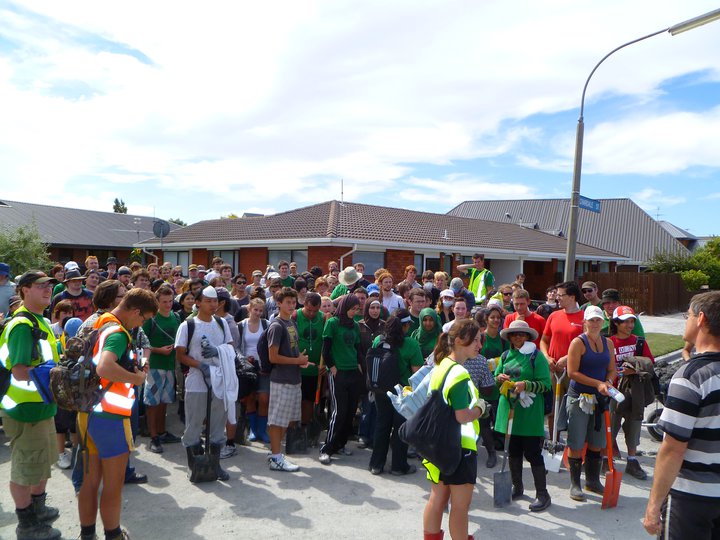

University student SamJohnston and a small core group of others, first organised 1-4000 students in September 2010 at
the time of 7.1 magnitude quake . Building on what they learned in that
experience, it took students only a week after the February aftershocks before they were communicating with
24,000 people. It wasn’t just face book and twitter that enabled this
astonishing, youthful coordinated effort. There were a raft of
pre-existing conditions that enabled young Christchurch citizens and many communities
like them to act in new ways. One of the first
common features of these successful citizenship initiatives is that they built
on existing organisations and networks, improving their communication and
relationships within, between and across different groups in the city.
The legacy of the spontaneous community co-ordination and regeneration is everywhere, in the new thinking of Gap Filler, and the recreation of public space through, for example: Greening the Rubble and new start up businesses of Life in Vacant spaces, or the experimental new economic models of Garden City 2.0 or the shared transition economies of Lyttleton.

These experiences echo the work of a third writer, Bonnie Honig whose thoughtful study in 2009 Emergency politics, reminds us that if “ political emergencies”
pose a threat to democratic life – we must pause and consider how should we respond democratically.
Honig asks, must
our only responses be to centralize top down decision making, countering the
growing power of the executive only by legal challenge? Or can we begin to
rethink democracy as a series of daily emergencies, in which, as she argues, our task is less about
focusing on disaster as an exceptional moment when we do everything differently
and more about maintaining democracy as a daily task: founding and re-founding democratic vision, ideals and practice in everyday life.
Summary -next steps and why icon projects are not the answer


Unfortunately because we’ve carried a command and control
form of decision making on, I argue in Christchurch we are actually now eroding our recovery in two key ways.
First we are eroding future leadership talent- we need to
plan for how the we will return the city and the region to elected, accountable
local decision making which effectively manages CERA and the city as they merge
their functions in the next two years.
At present there is almost no function left for a city council, we have
one Minister required to make all the decisions and that is simply not healthy
or helpful.
Secondly the idea of focusing our community recovery around a central city rebuild anchored by icon projects will prove problematic. Around the world we see how big icon buildings and stadiums, have often become lightening rods for tension in urban communities where squeezed middle income communities experiencing growing
inequality feel huge resentment about projects that are seen as costly and/or
favouring the needs of an elite or its
‘cronies’.
I think sadly we can expect the icon projects to be more of a source of
tension than inspiration -so for this reason its essential that decision making
returns to local accountable and elected leadership where decision making is
transparent and open to scrutiny and debate.
Studies by Mark Pelling at Kings College London, with Kathy Dil for Chatham House also show that
after a disaster, despite much discontent, power tends to be reinforced in some elite groups.

I’d like
to hope that doesn’t
happen here, I’d like to think that as a city we can do
things differently. We could recover together and become a more multicultural,
more egalitarian, caring and more innovative city. I hope we can.
A
Subscribe to:
Posts (Atom)